News
Australia's Disability Strategy is a national roadmap, guiding governments, businesses, and communities to work together to build a more inclusive Australia.
At its heart, the strategy exists to ensure people with disability can fully participate in Australian life with equal rights, real opportunity and respect.
To see how the disability community feels about the changes, lawyer, writer and disability advocate, Sam Drummond is travelling around the country talking to the people who are being impacted by the strategy.
The second episode of Building Inclusion, a Powerd Media podcast hosted by Sam, focuses on inclusive homes and communities, which is at the heart of what makes life accessible and fulfilling for people with disability. Too often, physical, social, and systemic barriers can make it difficult for people to live independently, participate in community life, and access essential services.
Australia's disability strategy recognises these challenges and sets out a national vision to address them. Its aim is to ensure that everyone can live in homes and communities that are safe, welcoming, and adaptable to their needs.
To find out how people with lived experience of disability are being included in the planning process, Sam spoke with CEO of Inclusively Made, Paul Nunnari, who advocates to transform disability representation in media, combining lived experience with strategic vision to embed authentic inclusion in every production.
Mr Nunnari draws on decades of experience driving systemic change - from making the Sydney Harbour Bridge wheelchair accessible to shaping inclusive policy for events like the Invictus Games, and was awarded the Public Service Medal in 2022.
Mr Nunnari previously worked with the New South Wales Department of Premier and Cabinet, where his role was to help ensure government events were accessible and inclusive. During his time there, he was invited to directly share his ideas with the premier shaping policy from the ground up.
I said ‘I work in your department. I'm a wheelchair user and I would love to see the Sydney Harbour Bridge become wheelchair accessible. Is there an option for us to put some lifts in’...Two weeks later, I got a response from one of the policy advisors saying the Premier really likes this idea. How do we make it happen?
Paul Nunnari
When asked how it felt to see his contribution implemented, Mr Nunnari explains that he was overjoyed.
“I was so proud when it opened, and to see universal design principles overlaid over this beautiful Sydney landmark and make it accessible for all in a way that can be enjoyed by all in a safe, dignified way is just so important.”
He believes that when barriers are removed, it gives the disability community the opportunity to achieve their potential.
“There’s going to be nothing in your way except for what's in your mind as to what you can achieve…The more barriers we can move, particularly under Australia's Disability Strategy and all the disability inclusion action plans that support that, then I'm very excited about the future.”
Sam then travelled to Victoria to speak with housing specialist, Joseph Connellan, who has over 30 years’ experience advising governments and shaping disability housing policy.
He now serves as senior manager in housing at the Melbourne Disability Institute and says moving vulnerable populations from inner-city communities to outer suburbs creates a false economy by increasing support costs and reducing social access.
It is more efficient to have somebody here in the inner city who requires support than it is to do it in Melton. Simply because of labour and access of workers and people to community and all those things. It's just this false economy because we separate off the whole equation. We separate housing off from the whole equation.
Joseph Connellan
To combat this, the accessible housing expert suggests that securing property ownership in central locations and moving beyond the group home models is essential for better life outcomes.
“If we look at the outcomes, not the physical form of the accommodation, you get quite different results,” he says. "I'm great believer in if you measure something, you actually care about it. We don't tend to measure this sort of stuff... so I think we should have a measure. We should have an objective."
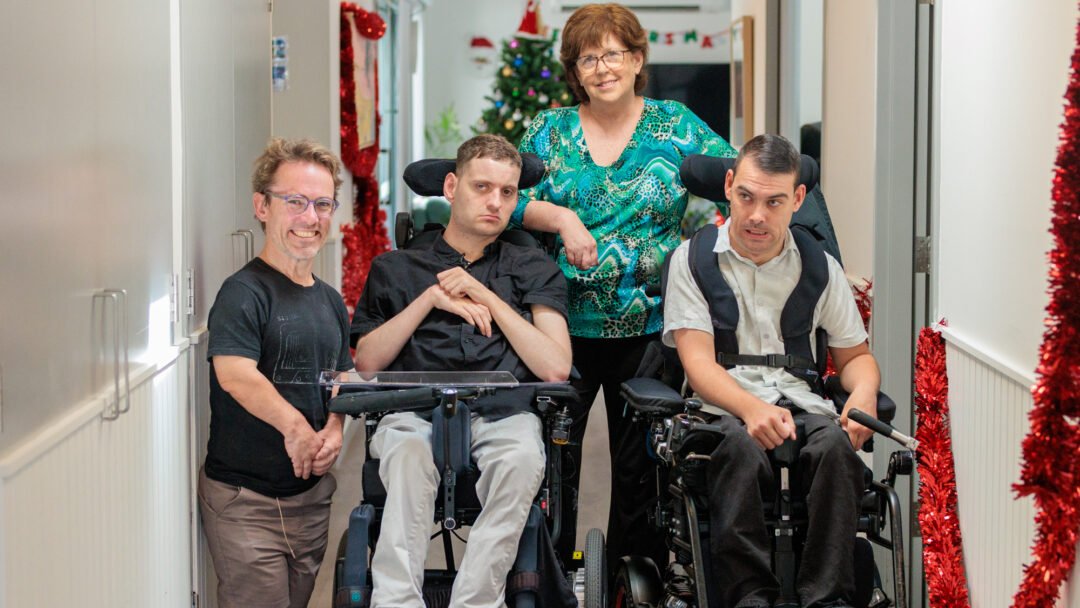
Staying in Victoria, Sam caught up with Nic and his mother, Joan Gains, in Melbourne's northern suburbs. Nick, a wheelchair user whose disability affects his speech, lives with two friends in a supported, fully accessible home funded through the NDIS. His house was designed to empower independence and community connections.
Ms Gains says her son enjoys his living arrangement as it gives him freedom and independence.
“He’s made so many friends, and he knows people throughout his community…that experience of watching it being built and meeting with the architects to say what they want in it,” she recalls. “The mums all talked and we thought we’d stay the first night. [The boys] told us that they didn't want to come home again. They loved it here.”
As a parent, Ms Gains says to see Nick not only living, but thriving in a secure environment is something they have both dreamed of.
For Nicholas to have his own independence and to know that he's got an extended family, friends, workers, that's less dependent on my ability to care for him…it's a very small world being looked after by your mother.
Joan Gains
“I think one of the best things is I get to be his mom. We have lunch together, dinner together. He visits me, but I don't have to…be the carer as well as the mom,” she says.
Finally, Sam headed to Darwin to catch up with Leeanne Caton, the CEO of Aboriginal Housing NT, the leading aboriginal controlled housing organisation in the Northern Territory.
A proud Kalkadoon one year woman. Ms Caton brings over 40 years of experience across government and community sectors, championing culturally safe, inclusive, and sustainable housing for Aboriginal communities.
Ms Caton explains that standard Western building designs often fail to meet the cultural needs and physical requirements of First Nation residents, particularly those living in remote areas with disabilities.
"Unfortunately, a lot of the houses that have been built in the past... do not have disability access,” she says.
If you're a person with…a wheelchair, you need a four wheel drive version due to the lack of sealed roads and driveways in remote communities…Unless you actually have lived experience, you don't get how hard it can [be] not to be able to roll a wheelchair into a house.
Leeanne Caton
The CEO of Aboriginal Housing NT says waiting for a suitable home through public housing can take up to tens years.
"We have 12 times the national percentage for homelessness, and that doesn't take into account the severe overcrowding that happens in aboriginal houses.”
"The whole process basically keeps people in poverty... because you need to stay unemployed and you need to stay under a certain income level in order to be able to be considered for that house,” Ms Caton claims. "We are challenging the system for appropriate housing for Aboriginal people, but disability access also needs to be taken into consideration."
If you liked this story, you can listen to the full episode of Building Inclusion, a podcast about Australia's Disability Strategy presented by Powered Media, right here.
This podcast by Powerd Media is supported by funding from the Australian Government Department of Health, Disability and Ageing under the Inclusion and Accessibility Fund: Australia's Disability Strategy (ADS) – Community Attitudes grant program.